
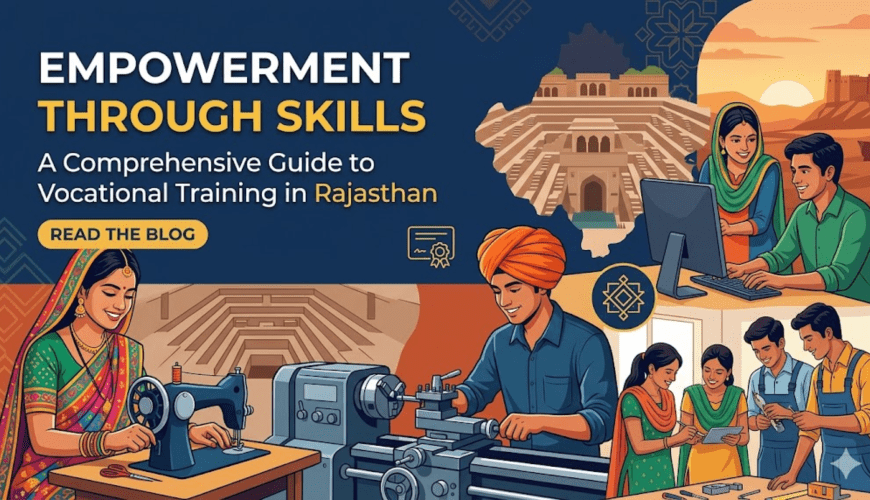
Empowerment Through Skills: A Comprehensive Guide to Vocational Training in Rajasthan
Rajasthan, a state known for its rich cultural heritage and majestic forts, is rapidly transforming into a significant industrial and technical hub. As the demand for a skilled workforce grows across India, the importance of technical education has never been more prominent. For thousands of students who have completed their 8th, 10th, or 12th standard, Industrial Training Institutes (ITIs) offer a direct and affordable path to professional employment.
The Evolution of Technical Education in North India
Vocational training in India has come a long way since its inception. Historically, traditional education focused heavily on theoretical knowledge, leaving a gap between academic certificates and industry requirements. To bridge this gap, the Directorate General of Training (DGT) and the National Council for Vocational Training (NCVT) established a framework that prioritizes “Learning by Doing.” In Rajasthan, this mission is spearheaded by the Department of Skill, Employment, and Entrepreneurship (DSEE).
Why Choose Vocational Training Over Traditional Degrees?
While a standard university degree takes three to four years, an ITI course typically lasts between six months and two years. This allows students from diverse economic backgrounds to enter the job market quickly. The focus is entirely on mechanical, electrical, and digital skills that are immediately applicable in factories, construction sites, and IT firms.
The Landscape of Industrial Training in the Desert State
The state government has invested heavily in creating modern workshops and infrastructure. From the bustling streets of Jaipur to the industrial zones of Bhiwadi and the marble hubs of Kishangarh, technical institutes are strategically placed to serve local industry needs.
Understanding NCVT vs. SCVT
Before diving into the college options, it is crucial to understand the two types of certifications:
-
NCVT (National Council for Vocational Training): A national-level certificate recognized across India and internationally. Most central government jobs require NCVT certification.
-
SCVT (State Council for Vocational Training): A state-level certificate. While highly respected within Rajasthan, its recognition might be limited in certain central government departments.
How to Navigate the Admission Process
Admissions to technical institutes in Rajasthan are usually merit-based, depending on the marks obtained in the qualifying school examinations.
Step-by-Step Registration Guide:
-
SSO Portal Integration: Most applications are processed through the Rajasthan SSO (Single Sign-On) portal.
-
Document Verification: Ensure you have your 10th-grade mark sheet, Domicile certificate, Caste certificate (if applicable), and Aadhaar card ready.
-
Choice Filling: During the counseling process, students can select their preferred trades and locations.
As you begin your search for the right institution, having access to the official government ITI college list in Rajasthan is the most critical step in ensuring you apply to an NCVT-affiliated center that offers subsidized fees and government-standard training equipment.
Top Technical Trades in High Demand
Selecting the right trade is just as important as selecting the right college. Based on the current industrial trends in 2026, here are the most sought-after skills:
1. Electrician (2 Years)
The backbone of any industry. Electricians are required in every sector, from domestic wiring to heavy industrial machinery maintenance.
2. Fitter (2 Years)
Fitters are the masters of precision. They work with metal parts to assemble and maintain machinery, making them indispensable in the manufacturing sector.
3. COPA (Computer Operator and Programming Assistant – 1 Year)
With the digital revolution, COPA has become one of the most popular non-engineering trades. It covers basic programming, database management, and internet technologies.
4. Mechanic Diesel (1 Year)
Crucial for the transport and heavy machinery industry, specifically for maintaining diesel engines in trucks, buses, and generators.
5. Solar Technician (1 Year)
Given Rajasthan’s position as a leader in solar energy, this trade offers immense future potential in the renewable energy sector.
District-Wise Industrial Hubs in Rajasthan
Rajasthan’s technical education is geographically distributed to support its specific industries:
-
Jaipur & Alwar: Focus on automotive, electronics, and general manufacturing.
-
Udaipur & Bhilwara: Focus on mining, textiles, and mineral processing.
-
Jodhpur & Bikaner: Focus on handicrafts, solar power, and mechanical engineering.
Opportunities After Completing ITI
The journey doesn’t end with a certificate. There are multiple pathways after graduation:
-
Apprenticeship Training: Students can join the National Apprenticeship Promotion Scheme (NAPS) to gain on-the-job training with a stipend.
-
Lateral Entry to Diploma: ITI graduates can take direct admission into the second year of a Polytechnic Diploma, furthering their engineering education.
-
Entrepreneurship: With schemes like MUDRA loans, many graduates start their own electrical shops, welding units, or repair centers.
Frequently Asked Questions (FAQs)
Q1: What is the age limit for admission into an ITI in Rajasthan?
The minimum age is generally 14 years. There is usually no upper age limit for most trades, allowing adult learners to reskill themselves.
Q2: Are there separate ITIs for women in Rajasthan?
Yes, the state has several dedicated “Mahila ITIs” (Women’s ITIs) that offer a safe learning environment and specialized trades like Dress Making, Cosmetology, and Secretarial Practice.
Q3: What is the average fee for a government ITI course?
Government institutions offer highly subsidized education. The fees are nominal, often ranging from ₹2000 to ₹5000 per year, which is significantly lower than those at private institutions.
Q4: Can I pursue a degree alongside an ITI course?
According to recent UGC and DGT guidelines, students can sometimes pursue dual qualifications, but it is recommended to check the specific university regulations regarding regular vs. distance learning.
Q5: When do the forms for Rajasthan ITI admission usually come out?
The admission cycle typically begins in May or June each year, following the declaration of the 10th and 12th-grade board results.
Conclusion: Shaping the Future of Rajasthan
Vocational training is the silent engine driving the “Make in India” initiative. By choosing a path in technical education, students in Rajasthan are not just gaining a job; they are gaining self-reliance. Whether you aspire to work for a multinational corporation or dream of starting your own workshop, the foundation laid in these classrooms is invaluable.
The journey to a successful career begins with research, the right trade selection, and timely application. As the state moves toward becoming a global manufacturing destination, your skills will be the most valuable currency you own.


