
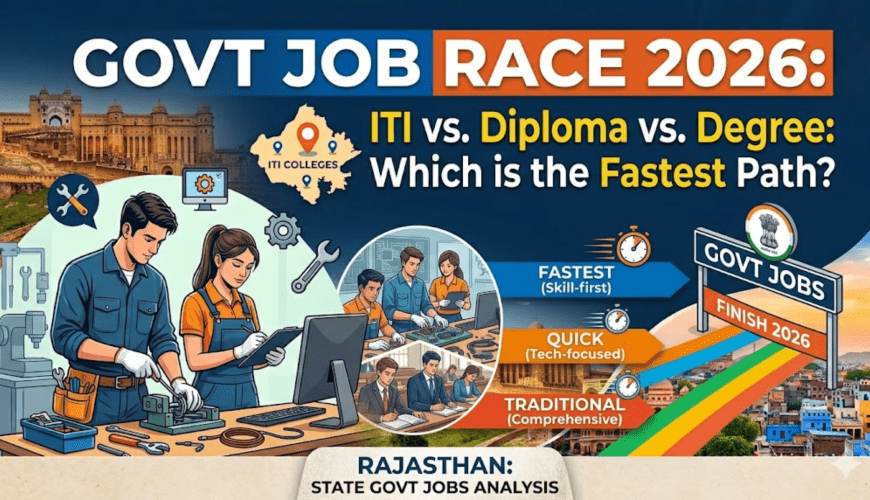
ITI vs. Diploma vs. Degree: Which is the Fastest Path to a Government Job in 2026?
The year 2026 marks a significant shift in the Indian employment landscape. With the rapid expansion of the “Make in India” initiative, the massive upgrade of the Indian Railways, and the surge in green energy projects, the demand for technical manpower has reached an all-time high.
If you are a student standing at the finish line of your 10th or 12th grade, you are likely facing the ultimate dilemma: Should you pursue an ITI certificate, a Polytechnic Diploma, or a full-fledged Engineering Degree? While each path has its merits, most students have one primary goal—securing a stable Government Job as quickly as possible. In this deep-dive analysis, we break down the timelines, the vacancy trends, and the competition levels to help you decide which route gets you that “Govt Employee” ID card the fastest.
The ITI Route: The “Expressway” to Technical Roles
If “speed” is your priority, the Industrial Training Institute (ITI) is undeniably the fastest vehicle. ITI courses are designed to be short-term, skill-intensive, and industry-aligned.
The Timeline Advantage
Most ITI trades, such as Electrician, Fitter, or Diesel Mechanic, take only 1 to 2 years to complete. This means that while a degree student is still in their second year of college, an ITI graduate is already eligible for major government entrance exams.
Where are the Vacancies?
The bulk of technical government vacancies in India are at the “Technician” or “Group C” levels.
- Indian Railways: Positions like Assistant Loco Pilot (ALP) and Technicians are almost exclusively reserved for ITI holders.
- State Electricity Boards (JVVNL, PSPCL, etc.): Massive recruitment for Linemen and Electricians.
- Defense & PSUs: ISRO, DRDO, and BHEL regularly hire ITI graduates for specialized workshop roles.
Competition Level
While the number of applicants is high, the “Skill Barrier” acts as a filter. Since these jobs require specific trade certificates, you aren’t competing with the general graduate population. This significantly increases your odds of selection.
The Diploma Path: The Balanced Middle Ground
A Polytechnic Diploma is often seen as the “Golden Mean.” It takes 3 years (or 2 years via lateral entry after 12th Science/ITI) and sits comfortably between a certificate and a degree.
The Junior Engineer (JE) Dream
The most coveted role for a Diploma holder is the Junior Engineer (JE). In the hierarchy of government departments like the PWD, WRD, or SSC JE, the Junior Engineer is the backbone of the technical team.
Why choose a diploma over ITI?
- Higher Entry Salary: A JE starts at a much higher pay scale than a Technician.
- Promotion Ladder: Diploma holders have a faster promotion track toward Assistant Engineer (AE) roles compared to ITI graduates.
- Versatility: You are eligible for both “Technical” and “Supervisory” roles.
The Degree (B.Tech/BE): The Long-Term Authority
A degree takes 4 years of intensive study. If you are looking for high-level administrative authority and the highest starting pay grades, this is your path—but it is rarely the “fastest.”
The Reality of Competition
The competition for “Officer” grade roles (like IES or UPSC) is astronomical. While an ITI student might compete with 50 people for one seat, a Degree holder often competes with 5,000 for a similar ratio in general administrative or high-level engineering roles.
Best For:
- Research & Development: Roles in BARC or ISRO (Scientist grade).
- Management: Direct entry as an Assistant Engineer or Executive Engineer.
Comparative Analysis: Speed to Employment
To make this easier, let’s look at the “Years to Job” ratio for a student starting after the 10th grade:
| Feature | ITI (Technician) | Diploma (Junior Engineer) | Degree (Engineer/Officer) |
| Duration | 1–2 Years | 3 Years | 6 Years (12th + 4 yrs) |
| Minimum Entry Age | 18 Years | 19–20 Years | 22–23 Years |
| Exam Difficulty | Moderate (Trade-specific) | High (Technical + Aptitude) | Very High (Intense Theory) |
| Average Vacancies | Very High | High | Moderate |
| Fastest Path Score | ⭐⭐⭐⭐⭐ | ⭐⭐⭐ | ⭐ |
Practical Insights: How to Choose in 2026?
Tip 1: Analyze Your Financial Situation
If you need to start earning and supporting your family within 24 months, ITI is your best bet. You can join a reputed institute like Bhushan ITI, master a trade, and sit for the Railway ALP exam by the age of 19.
Tip 2: Look at the “Skill India” Trends
Generative AI and Automation are changing the world, but they cannot replace a plumber, an electrician, or a mechanic on the ground. These “hands-on” technical roles in the government sector are the most “recession-proof” jobs available today.
Tip 3: The Lateral Entry Shortcut
Many smart students choose the ITI ➔ Diploma ➔ Degree ladder. By starting with ITI, you secure a technical base. You can then get into the 2nd year of a Diploma via lateral entry, allowing you to work and study simultaneously.
The Role of Quality Training
Securing a government job isn’t just about having a piece of paper; it’s about passing the competitive trade test. This is where the choice of institute becomes vital. Modern government exams in 2026 now include questions on Smart Grids, EV Technology, and Digital Controllers.
Institutes that offer advanced workshops and updated NCVT curricula give their students a massive head start in the written and practical exams.
Conclusion: The Verdict
If your goal is to land a government job in the shortest possible time, the path is clear: ITI is the winner. It offers the lowest entry barrier, the shortest course duration, and the highest frequency of “bulk” recruitments (like the Railways and State Electricity Boards). However, if you have the patience for a 3-year journey and want a supervisory role, the Diploma is your ideal match. The Degree should be reserved for those who aspire to lead departments and have the luxury of time for intense preparation.
Strong Takeaway: Don’t just chase a title; chase the role that fits your timeline. In 2026, the industry and the government value what you can do more than what you know.
Frequently Asked Questions (FAQs)
- Is ITI better than a Degree for Railway jobs?
For “Technician” and “Assistant Loco Pilot” roles, yes. These roles specifically require ITI certificates. Degree holders can apply for higher-tier management roles, but the number of vacancies for ITI holders is significantly higher.
- Can I get a government job immediately after ITI?
Yes, as soon as you complete your 1 or 2-year course and receive your NCVT/SCVT certificate, you are eligible to apply for various state and central government technical exams.
- Which ITI trade is best for government jobs in 2026?
Electrician, Fitter, and Diesel Mechanic remain the top three trades due to high demand in the Railways and Power sectors.
- What is the average starting salary for a Govt ITI Technician?
The starting salary (Basic + Allowances) generally ranges from ₹25,000 to ₹35,000, depending on the department and the city of posting.
- Does a Diploma holder have more job security than an ITI holder?
In the government sector, job security is equal for both. The main difference lies in the salary grade and the nature of the work (Practical vs. Supervisory).
- Can I study for a Degree while working a Govt job after ITI?
Absolutely. Many government employees use “Distance Learning” or “Part-time” programs to upgrade their qualifications while maintaining their job seniority.
- Why is the competition lower in ITI government exams?
Because ITI exams are “Trade Specific.” A person with a COPA certificate cannot apply for an Electrician role. This specialization naturally reduces the number of eligible candidates compared to general graduate exams.


