
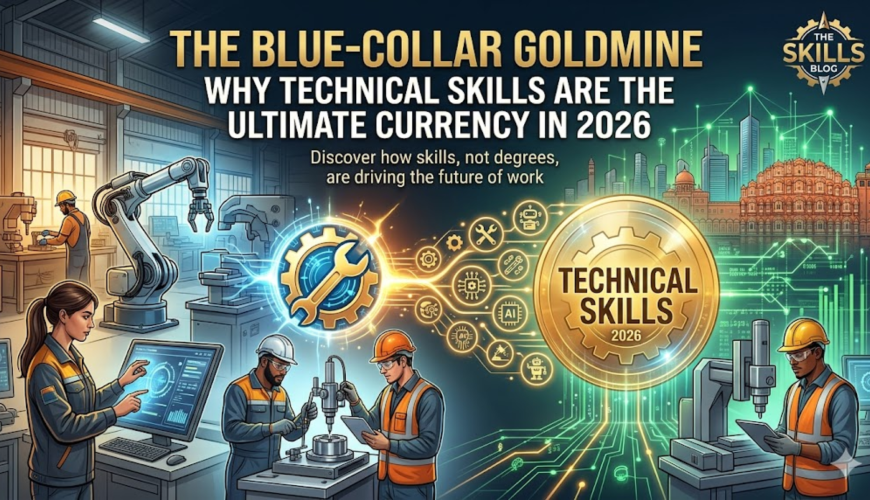
The Blue-Collar Goldmine: Why Technical Skills are the Ultimate Currency in 2026
In the previous decade, the traditional four-year university degree was seen as the only “golden ticket” to a middle-class life. However, as we move through 2026, the economic landscape has shifted dramatically. While thousands of general degree holders struggle with unemployment, there is a massive, unfilled vacuum in the industrial sector. The world is facing a shortage of “doers”—the technicians, electricians, and mechanics who keep our infrastructure running.
Choosing a vocational path isn’t just a backup plan anymore; it is a strategic career move. This long-form guide explores the revolution in industrial training and how a focused technical education can lead to a more stable and lucrative future than many white-collar roles.
The Death of the Generalist and the Rise of the Specialist
We are living in the age of specialization. Industry 4.0 has introduced smart factories, IoT-enabled machinery, and complex electrical grids that require a specific set of skills to maintain.
Why General Degrees are Failing
Most academic degrees focus on “what to think,” but industries today need people who “know how to do.” The gap between theoretical knowledge and practical application has never been wider. Vocational training closes this gap by providing an immersive environment where the workshop is the primary classroom.
The Economic Shield
Technical skills provide a unique form of job security. You cannot outsource the repair of a local power grid or the maintenance of a manufacturing assembly line to a different country. These are “on-site” essential roles that offer a high degree of protection against economic downturns and AI-driven automation.
Setting the Standard: Bhushan ITI College
When it comes to building a foundation for these skills, the choice of institution is paramount. It is not enough to simply attend any ITI college; one must find a center that bridges the gap between old-school mechanics and modern technology. Among the leaders in this space, Bhushan ITI College has distinguished itself by creating a curriculum that evolves as fast as the industry does.
By prioritizing state-of-the-art workshops over traditional lecture halls, such institutions ensure that when a student graduates, they don’t just have a certificate in their hand—they have the muscle memory and technical intuition required to handle high-stakes industrial environments. This “Industry-First” approach is what differentiates a standard technician from a high-value specialist.
High-Demand Trades: Where the Jobs Are in 2026
To maximize your Return on Investment (ROI) in education, you must choose a trade that aligns with the future of the global economy. Here are the top-performing sectors:
A. The Electrical Revolution
The global push for green energy has transformed the Electrician trade. In 2026, an electrician isn’t just fixing ceiling fans. They are:
- Installing and maintaining Solar Photovoltaic (PV) systems.
- Managing Electric Vehicle (EV) charging infrastructure.
- Programming Smart Home automation systems.
- Maintaining high-voltage industrial transformers.
B. The Precision of the Fitter Trade
The Fitter trade remains the heartbeat of the manufacturing sector. As India becomes a global hub for electronics and defense manufacturing, the demand for precision fitters who can read complex blueprints and assemble micro-mechanical parts is at an all-time high. This trade offers a direct path into the aerospace and automotive sectors.
C. The Evolution of the Mechanic
Gone are the days of the simple grease monkey. Modern Mechanic Diesel and Motor Mechanic trades now involve diagnostic software and sensor calibration. With the rise of hybrid engines and high-efficiency transport fleets, a modern mechanic is part-computer scientist and part-engineer.
The Path to Government and Public Sector Jobs
One of the biggest draws of an ITI certification is the sheer volume of government job opportunities. In India, the Public Sector Undertakings (PSUs) and the Indian Railways remain the largest employers of technical talent.
- Indian Railways: Roles like Assistant Loco Pilot (ALP) and specialized technicians are exclusively reserved for ITI holders.
- Electricity Boards: State-run power corporations require thousands of linemen and wiremen every year.
- Defense & Aerospace: From HAL to the Ordnance Factories, technical hands are needed to maintain the machinery of national security.
The stability, pension schemes, and healthcare benefits of these roles make a technical diploma one of the most sought-after credentials in the country.
Entrepreneurship: Being Your Own Boss
Perhaps the most underrated benefit of vocational training is the ability to start a business with very low capital. Unlike a corporate employee, a skilled technician carries their “factory” in their toolkit.
- Service Centers: Opening a specialized multi-brand vehicle service center.
- Electrical Consultancy: Providing safety audits and smart-home installations for new residential projects.
- Manufacturing Units: Setting up small-scale units for spare parts or specialized welding.
By the age of 25, many ITI graduates are not just earning a salary; they are employing others.
How to Choose the Right Training Institute
If you are looking to enroll, keep this checklist in mind to ensure you get the best quality education:
- NCVT vs. SCVT: Always prioritize National Council for Vocational Training (NCVT) affiliation for better job prospects abroad and in the central government.
- Workshop Quality: Visit the campus. Are the machines modern? Is there enough equipment for every student to practice?
- Industry Tie-ups: Does the college have partnerships with local industries for internships and apprenticeships?
- Alumni Success: Where are the previous students working? A strong alumni network is a sign of a healthy placement cell.
The Global Perspective: Technical Skills Abroad
The shortage of skilled tradespeople is a global phenomenon. Countries like Canada, Germany, Australia, and the UAE have dedicated visa pathways for skilled technicians. If you hold a valid certification and have 3-5 years of experience, the doors to international relocation are wide open, often with higher pay scales than general administrative roles
Conclusion: The Future is in Your Hands
The narrative around “success” is changing. In 2026, the real winners are those who can navigate the physical world with technical expertise. Whether you are looking at Bhushan ITI College or exploring other vocational avenues, remember that a skill is an asset that never depreciates. The machines of the future will still need humans to build, fix, and optimize them.
Don’t just look for a job—build an indispensable career.
Frequently Asked Questions (FAQs)
1. Is ITI equivalent to a 12th-grade certificate?
In many states, completing a 2-year ITI course after the 10th grade is considered equivalent to the 12th grade for the purpose of pursuing higher education like a BA or B.Com.
2. Can I pursue Engineering after ITI?
Yes! You can take the “Lateral Entry” route into a Diploma in Engineering, which allows you to skip the first year. From there, you can even pursue a B.Tech.
3. What is the average fee structure?
ITI fees are very affordable, ranging from ₹5,000 to ₹25,000 per year depending on the trade and whether the institute is government or private.
4. Are there any computer-based trades?
Yes, the COPA (Computer Operator and Programming Assistant) trade is perfect for those who want to work in IT, data entry, and office automation.
5. What is an Apprenticeship?
An apprenticeship is “on-the-job” training where you work in a real factory while finishing your course. You usually receive a stipend (salary) during this period.
6. Is there a physical fitness requirement?
For most trades, general health is enough. However, for certain roles in the Railways or Defense, there may be specific eyesight and physical standards.
7. Which trade has the highest salary?
Currently, the Electrician and Fitter trades tend to have the highest starting salaries due to the massive demand in the construction and manufacturing sectors.


